Part I – Report Overview
ITEM 1. Disclaimers, Disclosures and Notes
Introduction
These financial statements were prepared by Cowrie – Administrator Services LLC ("Administrator Services"), which has been authorized as a member of Structura to perform a variety of administrative responsibilities, including the preparation of quarterly and annual financial statements in support of quarterly tax updates.
The Quarterly Financial Statements (“QFS”) for Structura for the three- and nine-month periods ended September 30, 2026 also include the calculation of estimated U.S. federal income tax liabilities, conducted in accordance with the current standards, rules, and interpretive guidance under the Internal Revenue Code (“IRC”) and relevant US Treasury regulations.
Purpose and Basis of Presentation
The preparation of these financial statements is guided by a primary objective: to analyze the financial activities of Structura with the express intent of estimating its potential U.S. federal and state income tax obligations. The QFS were not prepared under Generally Accepted Accounting Principles (“GAAP”). Rather, Administrator Services has selectively employed GAAP-informed principles and valuation methodologies where necessary to ensure internal consistency, defensible estimations, and analytical rigor. Please refer to the ITEM 3. Accounting and Tax Policy section below for further discussion.
These statements do not fall under the purview of AR-C Section 70, Preparation of Financial Statements, of the AICPA Statements on Standards for Accounting and Review Services (SSARS), as the preparation is auxiliary to our core tax engagement services. Likewise, AR-C Section 80 and AR-C Section 90 do not apply because we are not performing compilation or review services, respectively.
It is essential to emphasize that these financial statements are exclusively intended for Structura’s internal use and limited to the specific purposes outlined above. The methodology and scope of this report are tailored to the unique operational characteristics and decentralized governance model of the entity. Furthermore, while Structura has influence over certain structural parameters of the Shape Network (the “Protocol”), it does not exert ownership or managerial control. Accordingly, the financial results and associated tax estimates presented here do not include or reflect broader financial activities occurring at the protocol layer or among unrelated stakeholders in the broader Shape ecosystem.
Source of Financial Data
The decentralized nature of Structura imposes distinct challenges with respect to the sourcing and consolidation of financial data. Unlike traditional enterprises that maintain centralized financial systems, there is no internal finance department. Accordingly, Administrator Services compiled financial data exclusively from blockchain transaction records associated with DUNA-controlled wallets (“Treasury Wallets”) and from offchain transactions executed under the scope authorized by Structura (e.g., vendor payments, tax payments, interest earned on bank account balance).
Nature and Limitations of the Financial Statements
The QFS prepared herein do not constitute audited financial statements and do not purport to meet the disclosure or presentation requirements applicable under SEC rules or AICPA and PCAOB audit standards. These financial statements have not undergone an audit or review by an independent third party. Administrator Services is not an accounting firm and cannot guarantee the absence of material misstatements.
Accordingly, these financial statements should not be relied upon to detect misstatements, irregularities, fraud, or noncompliance with applicable laws and regulations. The absence of a centralized control environment and the pseudonymous nature of blockchain transactions mean that financial reporting under a DUNA model is subject to novel risks, including incomplete records, classification uncertainty, and data omissions.
It is essential that users of these financial statements exercise discretion and interpret the contents as a best-effort, good-faith, and methodologically sound approximation of Structura’s financial activity within the defined reporting period. These statements should not be regarded as comprehensive or verified financial records. They are not a substitute for independently audited financial statements and are provided without any warranties, express or implied, as to their completeness or accuracy.
ITEM 2. Structura
Structura Overview
The Structura DUNA (“Structura” or “the Association”) is the membership body composed of participating governance tokenholders with governance rights over the SHAPE tokens held in the Structura Treasury and governance of Structura. Structura was initially organized as a WY Unincorporated Nonprofit Association (“UNA”) on January 1, 2026 and operated as an eight-member entity prior to token distribution, at which point it transitioned to a WY Decentralized Unincorporated Nonprofit Association (“DUNA”) on March 19, 2026 once the 100-member threshold was met.
Membership in the DUNA results from holding SHAPE and actively participating (e.g., voting, delegating, submitting proposals, or staking); mere token ownership without participation does not constitute membership.
Members do not own Structura’s property and per-capita distributions are prohibited other than upon windup and dissolution.
Structura’s mailing address is:
Structura
3306 Kelley Drive
Unit 1102
Cheyenne, WY 82001
Tax Election
Upon formation, Administrator Services filed Form 8832 with the Internal Revenue Service (“IRS”) to elect classification of Structura as a C Corporation for U.S. income tax purposes and obtained an Employer Identification Number.
As a C Corporation, Structura’s operations are taxed at the standard 21% U.S. federal income tax rate for corporations. Structura has not elected to be treated as a tax-exempt entity under section 501(c) of the Internal Revenue Code.
Tax Reporting
While DUNAs are not required to maintain member listings, both Structura and recipients of any outbound disposition from the Structura Treasury must comply with relevant tax reporting requirements.
Treasury and Ecosystem Funding
As of September 30, 2026, the Structura Treasury contained 1,930,000,000 SHAPE tokens, inclusive of 200,000,000 SHAPE tokens allocated for the Pioneer Grants Program and 250,000,000 SHAPE tokens held for potential future airdrops. Structura also held 3,105,885,467 SHAPE tokens in a Safe multi-sig, to be allocated to staking reward contracts when ready.
The use of Structura’s Treasury is determined by the Association’s governing principles, which provide token governance procedures for submitting and approving proposals, as well as voting and membership.
Shape Network
The Shape Network is an Ethereum Layer 2 blockchain, built on the OP Stack and operating as a member of the Optimism Superchain, purpose-built as a permissionless and EVM-equivalent network for creators and the onchain object economy. The protocol provides an open environment where anyone can create, deploy, and interact with programmable onchain objects, spanning fine art, digital collectibles, and experimental applications, with security inherited directly from Ethereum. The Shape Network's core economic mechanism, Gasback, returns 80% of sequencer fees to smart contract owners, structurally aligning the Protocol's revenue model with the creators and builders who generate its activity.
The SHAPE token functions as the native token for the Shape Network, aligning incentives among developers, users and governance tokenholders.
Additionally, the SHAPE token provides the mechanism for membership in Structura, as holders are able to participate in governance decisions around the functionality of existing protocol parameters and to vote on how the SHAPE tokens held in the Structura Treasury are utilized to support reliability, security and ecosystem growth for the Shape Network.
ITEM 3. Accounting and Tax Policy
Overview of Accounting and Tax Policy Framework
Administrator Services prepared the special-purpose QFS for Structura to evaluate its revenues and expenses with the ultimate objective of estimating potential U.S. federal and state income tax liabilities. This section outlines how Structura manages its financial reporting and tax obligations. The aim is to ensure a clear, consistent method for recognizing income and expenses, ultimately to estimate potential U.S. federal and state tax liabilities.
An accounting method is the set of rules that determine when and how income and expenses are recognized on financial statements and tax returns. An entity can use different methods for financial book vs. tax purposes (e.g. accrual for financial statements, cash for taxes), but whichever methods are chosen must clearly reflect income and be applied consistently year to year. Once an entity adopts a method, it must continue with it in subsequent years barring a justified change. In Structura’s case, both financial reporting and tax reporting use the accrual basis, as detailed below.
Financial Reporting Approach: Accrual Method
Structura uses the accrual method of accounting for its financial statements. This provides a more accurate and comprehensive view of the DUNA’s financial situation by recognizing revenues when earned and expenses when incurred, regardless of when cash is actually transferred. Under accrual accounting, unrealized gains and losses on Designated Tokens (defined below) are recognized, and deferred tax assets/liabilities are recorded for timing differences between book and tax treatments. This approach ensures the financial statements capture the full economic activity, not just cash flows. For example, if the SHAPE tokens held in the Structura Treasury appreciate during the period, that unrealized gain is reflected in the book financial statements (with a corresponding deferred tax liability for the expected taxable gain in the future).
Tax Reporting Approach: Accrual Method
For U.S. income tax purposes, Structura also reports on an accrual basis. Under IRC §446, taxpayers are generally allowed to use the method of accounting they use for their own books (cash, accrual, or other) so long as it clearly reflects income.
Under an accrual method of accounting, income and expenses are reported based on when they are earned or incurred, not when cash changes hands. In plain terms, this means an accrual-basis taxpayer generally reports income in the tax year it is earned (regardless of when payment is received) and deducts expenses in the tax year when the liability is incurred (regardless of when payment is made). This approach differs from the cash method and is grounded in specific tax rules (primarily IRC § 451 for income and IRC § 461 for expenses) that ensure revenue and corresponding expenses are matched to the correct period.
Income recognition (all-events test)
For tax purposes, IRC § 451 and the related regulations require that an accrual-method taxpayer recognize income once the “all-events test” is met. This test is satisfied when all events have occurred that fix the right to receive the income, and the amount can be determined with reasonable accuracy. In practice, this generally means income is considered at the earliest of the following: (1) when the required performance or service has been provided (i.e. the earnings process is complete), (2) when payment is due from the customer, or (3) when payment is actually received – whichever occurs first. By following this rule, taxpayers ensure that revenue is reported in the correct period (for example, if the DUNA earns fees or rewards in Year X, it must include them in Year X’s income even if the cash is received later). This approach is consistent with tax authority guidance and case law enforcing early recognition once the right to income is fixed.
Expense recognition (liability and economic performance)
On the expense side, accrual-method taxpayers deduct or accrue expenses when the liability is incurred, which similarly hinges on an all-events test plus an economic performance requirement. In simple terms, a business may deduct an expense only after: (1) all events have occurred that establish the fact of the liability, (2) the amount of the liability can be determined with reasonable accuracy, and (3) economic performance has occurred with respect to that liability. Economic performance means that the underlying goods or services tied to the liability have been provided – in other words, the obligation has been “performed” either by the other party or by the DUNA, as applicable. For example, if the DUNA owes a vendor for services, the expense would be accrued in the year the vendor provides those services (i.e., when the vendor performs), even if the payment is issued later. Only once an obligation is fixed and the service or product has been delivered (or used) is economic performance met, and the expense is incurred for tax purposes. This rule, found in IRC § 461(h) and related Treasury regulations, ensures that deductions are not taken too early. The DUNA cannot deduct a cost until it is firmly attached to a completed transaction or service.
Revenue and Income Recognition
Structura recognizes income from all sources including digital asset transactions in the year the income is earned, due or becomes available. This policy applies equally to financial statements and tax filings. However, a key exception involves unsolicited tokens received in DUNA-controlled wallets. In the digital asset ecosystem, it is common for unknown third parties to unilaterally send tokens, whether valuable or worthless, to publicly known wallet addresses, including those under Structura’s control. These transfers occur without the recipient’s consent and cannot be refused at the protocol level. This means the DUNA might passively receive tokens it never intended to hold.
To mitigate the risk of unintended income tax exposure, unsolicited transfers do not constitute income to Structura when received as a matter of policy.
This formal policy means that only tokens which Structura has intentionally and willfully transacted (termed “Designated Tokens”) will be recognized in the accounting records. As of September 30, 2026, SHAPE (the Protocol’s governance token) and ETH were the only Designated Tokens under this definition. Any other tokens sent to the Treasury Wallets by unknown parties are ignored in the financial reports and tax computations, as they were neither solicited nor used by the DUNA. Unsolicited Designated Tokens, such as SHAPE sent to the Treasury Wallet by unassociated third parties, will not be included in accounting records.
Accounting for Income from Airdrops
Airdrops refer to token distribution events initiated by blockchain protocol or token projects, where tokens are allocated, typically free of charge, to select wallet addresses. These events often serve as go-to-market strategies designed to drive user adoption, decentralize ownership, reward early supporters, or stimulate onchain activity.
If Structura actively solicits or consents to receive an airdropped token (for instance, as part of a partnership or application for a distribution), and subsequently does receive those tokens, then the fair market value (“FMV”) of the tokens at receipt will be recognized as ordinary income for U.S. tax purposes and as revenue in the DUNA’s financial statements. The FMV is determined at the time of receipt using the spot market price for the token multiplied by the quantity received. This treatment complies with U.S. tax regulations (income is recognized when one has dominion and control over assets received) and ensures the financial statements reflect all earned resources.
Notably, this recognition occurs regardless of whether the DUNA immediately liquidates the airdropped tokens or holds them, and irrespective of subsequent price fluctuations. The full value at receipt is counted as income.
This policy on airdrops applies to both tax and book accounting, following IRS guidelines by treating airdropped tokens as income at the time they become the DUNA’s property.
SHAPE Disbursement Under Governance Consensus
One of the key functions of Structura is to support the ongoing development of the Shape Network and the broader Shape ecosystem. In alignment with its decentralized governance model, Structura governance proposals may authorize the disbursement of SHAPE tokens from the DUNA’s Treasury to fund protocol development initiatives or broader ecosystem growth.
When such disbursements are approved, the required amount or number of tokens is transferred to an external party or vendor based on either the nominal amount or a specified token value as determined by Structura governance.
For U.S. federal income tax and financial reporting purposes, token disbursements from the DUNA’s Treasury are treated as comprising two distinct tax accounting transactions:
- Token Disposition: The initial transaction is treated as a sale of the disbursed tokens upon transfer from the Treasury Wallets.
- Expense Recognition: The second transaction pertains to the accounting treatment of the resulting proceeds from the token disposition.
This two-step view is required because under U.S. tax law, cryptocurrencies are property, pursuant to IRS Notice 2014-21. Spending tokens is thus not just an expense; it triggers a disposition of an appreciated asset. Below we detail each component:
Token Disposition (Capital Gain/Loss on Token Transfers)
According to IRS Notice 2014-21, 2014-16 I.R.B. 938, cryptocurrencies are classified as property for U.S. federal income tax purposes. Accordingly, when Structura transfers out tokens from its treasury (e.g. sending SHAPE to a grant recipient), in exchange for property (including money) or services, it is treated as a taxable sale or exchange of those tokens at the market price at the time and date of the transfer. Under IRC § 1001, the DUNA must calculate and recognize a capital gain or loss on that sale or exchange. The gain or loss is computed as follows:
Capital Gain = Gross Proceeds from Sale of Disbursed Tokens – Cost Basis of Tokens Sold
- Gross Proceeds: The value received for the tokens. In the context of a treasury disbursement, this is taken as the market price of the token at the time of the transfer multiplied by the number of tokens disbursed. Since no cash is received, Structura will treat the tokens’ market value as the proceeds of a deemed sale.
- Cost Basis: The original value of those tokens to Structura. For initial SHAPE tokens minted and received in the DUNA Treasury, the cost basis is the total number of SHAPE tokens deposited in the treasury multiplied by the FMV of each token determined by a valuation specialist in a token valuation report, which the DUNA recognized as ordinary income in the first quarter of 2026.
All such token dispositions are reported to the IRS (e.g. on Form 8949 and Schedule D of the corporate tax return) detailing the asset, date acquired, date disposed, proceeds, basis, and resulting gain or loss. From a financial reporting perspective, the act of disbursing tokens is similarly treated as realizing any built-in gain/loss on those tokens. This ensures the financial statements reflect the economic impact of using appreciated assets to fund expenses.
Expense Recognition (Use of Token Sale Proceeds)
The second part of the transaction is recording the expense for which the tokens were used. The accounting and tax treatment depends on what the expense relates to, which must be evaluated by the nature of each disbursement to determine the proper classification:
- If the expenditure is in furtherance of Structura’s operational mission (development, community growth, etc.), it will generally be a business expense. For U.S. tax, most ordinary and necessary business expenses are deductible under IRC §162(a). For financial statements, it will be recorded as an expense in the appropriate category (e.g. “Grants expense” or “Legal expense”).
- If the expenditure is of a type that is not deductible for tax, such as lobbying and political spending or payment of U.S. federal income tax, then no tax deduction is taken even though it’s recorded as an expense in the financial books.
Each expense is considered on a case-by-case basis, but they fall into common categories. Below we outline the major expense categories that Structura is expected to incur, with their typical tax treatment:
Major Expense Categories and Tax Treatment
Pioneer Grants Program
Structura’s Pioneer Grants Program provides SHAPE tokens or other resources to developers, researchers, community initiatives, or other recipients that contribute to either Shape Network’s or Structura’s growth and development.
Tax Treatment: Tokens disbursed as grant awards are treated as ordinary business expenses if they further the DUNA’s operations. These are deductible under IRC §162(a) as they are aimed at maintaining or expanding the Shape Network ecosystem, which is the core purpose of the DUNA.
Financial Reporting: Recorded as “Grant expenses” on the income statement in the period they are approved and distributed.
General & Administrative (G&A)
G&A covers the day-to-day expense overhead of operating the DUNA. This includes routine expenses such as software subscriptions, governance administration, treasury custody management, accounting/bookkeeping services, coordinator stipends, governance tooling, compliance and treasury management services, etc. These are the routine costs of keeping Structura functional and are not tied to specific product development.
Tax Treatment: G&A expenses are deductible business expenses under IRC §162(a) as ordinary and necessary costs of operating the DUNA. Even as a nonprofit, the DUNA can deduct these operational costs since they directly support its activities.
Financial Reporting: Recorded as “General & Administrative Expenses” in the period incurred.
Legal
Legal expenses encompass costs for attorneys, legal filings, regulatory compliance, and any counsel retained to advise the DUNA. This includes fees for setting up the DUNA’s legal structure, drafting contracts (e.g. grant agreements), obtaining regulatory advice, and any litigation or legal defense if it arises. Essentially, this is the budget for navigating laws and regulations, ensuring the DUNA’s activities are lawful.
Tax Treatment: Legal and professional fees that are directly related to the DUNA’s operations are deductible under IRC §162(a) as ordinary and necessary expenses. (An exception would be if any portion is for something non-deductible, but generally legal fees for business purposes are deductible.)
Financial Reporting: Recorded as “Legal Expenses” on the income statement.
Political Contributions & Lobbying
This category captures any spending aimed at influencing legislation, regulation, or public policy. It could include hiring lobbyists or advocacy firms, making donations to industry advocacy organizations, or funding grassroots campaigns to educate policymakers. Transparency is critical here because these expenses can be controversial and have special tax rules. These expenses are expected to be occasional and purpose-specific (not routine operations).
Tax Treatment: Not deductible. U.S. tax law expressly disallows deductions for lobbying and political expenditures (IRC §162(e)). If Structura spends treasury funds on lobbying efforts or political contributions, those costs cannot reduce its taxable income.
Financial Reporting: Recorded as “Lobbying Expense” or “Political Contribution” in the financial statements as an expense, which will reduce book income, but with a note that it is non-deductible for U.S. tax purposes.
DUNA Operations
These are expenses related to running and compensating the committees of the DUNA. Although Structura is a decentralized community, certain limited authorizations of authority are formalized. For example, the DUNA may appoint a committee with authorizations defined by governance proposal. Operational costs could include salaries or stipends for committee members, auditors, or other agents that the DUNA engages to perform work.
Tax Treatment: These operational costs are deductible business expenses (IRC §162(a)), since they are ordinary and necessary for the DUNA to function. Paying people to execute the DUNA’s decisions is a fundamental expense of running the organization.
Financial Reporting: Recorded as “DUNA Operations” or similar expense category in the financials.
Research & Development (R&D)
R&D expenses are investments in innovation, future growth, and major improvements to the Shape Network and ecosystem. This covers spending on developing new features or products, experimenting with upgrades, auditing new protocol versions, scalability research, and academic collaborations. Unlike routine maintenance, R&D is about building the future of the Shape Network, work that may not have guaranteed success but could significantly advance the protocol if successful. Structura may fund internal committees or external developers/researchers to undertake such projects (often via grants).
Tax Treatment: Generally, R&D costs can be deductible as ordinary business expenses (or subject to special R&D capitalization rules under IRC §174).
Financial Reporting: Recorded as “Research & Development” or similar expense category in the financials.
Sales and Marketing
This category includes spending to promote the Shape Network and grow its user base and community. Even a decentralized project benefits from outreach and marketing to drive adoption. These expenses can cover advertising campaigns, branding and design work, sponsorships of events or hackathons, community meetups, educational content creation, and programs to incentivize usage.
Tax Treatment: Marketing and promotional expenses are deductible under IRC §162(a) as ordinary business expenses. They are akin to advertising costs, which are routinely deductible.
Financial Reporting: Recorded as “Sales and Marketing Expenses” in the financial statements.
Security (Audits & Bug Bounties)
Security is paramount for a blockchain protocol. This category covers expenditures to ensure the security of Shape Network’s smart contracts and infrastructure. It includes the cost of external security audits, code review engagements, ongoing monitoring services, and bug bounty programs to reward responsible disclosure of vulnerabilities. Essentially, any funds spent to identify, prevent, or mitigate security risks fall in this bucket.
Tax Treatment: Security expenses are deductible business expenses under IRC §162(a). They are ordinary and necessary costs of maintaining a secure protocol operation. Investing in audits and bounties is akin to an insurance or quality assurance expense for the business.
Financial Reporting: Recorded as “Security Expenses” or included under a broader engineering expense category in the financial statements.
Income Taxes
For financial reporting purposes, Administrator Services records income tax provisions as follows:
- Current Tax Liabilities/Assets: Based on taxable income or loss for the year, the DUNA will estimate the federal and applicable state corporate income tax due for that year. A liability is recorded for taxes expected to be paid, or an asset if there are tax refunds due to overpayments; the benefit of net operating losses carried forward is recorded as a deferred tax asset (see below).
- Deferred Tax Assets/Liabilities: These reflect future tax impacts from temporary differences between book accounting and tax accounting. The primary source of temporary differences for Structura is likely to be unrealized gains or losses on Designated Tokens. For example, if Structura’s SHAPE Treasury appreciates in value on the books (creating an unrealized gain that would increase book income), U.S. tax law would not tax that gain until the tokens are sold. This creates a deferred tax liability, which is a future tax due when the gain is realized from sale of the appreciated SHAPE tokens. Conversely, if the DUNA had an expense that is recognized now for book but only deductible later for tax, that would create a deferred tax asset (i.e., future tax savings). Administrator Services evaluates these differences each period and records deferred taxes accordingly.
The net effect is that the financial statements’ income tax expense reflects both current taxes and deferred taxes. This gives a clearer picture of the DUNA’s total tax position.
U.S. tax law expressly disallows tax deductions for amounts paid for current federal income tax.
Balance Sheet Presentation
On the balance sheet, Structura’s crypto assets are classified as marketable property. This classification is due to their high liquidity – SHAPE and ETH can be readily converted to cash at observable market prices. The treasury’s tokens are reported at FMV as of the balance sheet date. Unrealized gains or losses from revaluing these tokens to fair value are recognized in the income statement each period. This is in line with accrual accounting and reflects economic reality, but it does create the deferred tax impacts mentioned above.
All Designated Tokens (currently SHAPE and ETH) that the DUNA holds will appear as assets on the balance sheet. The SHAPE tokens held within the treasury are a significant asset – the Structura treasury held roughly $1.5 million in SHAPE as of September 30, 2026, which are subject to market fluctuations. Using fair value accounting means the balance sheet always shows the latest market value of the treasury.
Fair Value of Designated Tokens
At each reporting date, Administrator Services determines the fair value of each Designated Token held in the DUNA’s treasury. The carrying value of these tokens on the balance sheet is updated to the spot price as of the last second (11:59:59 PM Mountain Time) of the period multiplied by the quantity of tokens held.
Using observable spot prices ensures the valuation is objective and current. Any change in value from the previous period’s valuation is recognized as an unrealized gain or loss in the income statement. If SHAPE’s price rose during the quarter, the gain increases net income. If the price fell, an unrealized loss would reduce net income.
In summary, the balance sheet presentation provides a clear picture of the fair market value of Structura’s token holdings by listing its treasury at fair value. The consistent fair value policy, combined with the accounting and tax policies above, provides transparency and accuracy in how Structura reports its financial position and performance. Each practice, from accrual accounting, to recognizing only designated tokens, to detailed expense categorization, is intended to support clear, conservative financial reporting and compliance with U.S. tax laws.
Part II - Financial Information
ITEM 4. Balance Sheet (unaudited) – For Informational Purposes Only
Assets:
Cash and Cash Equivalents
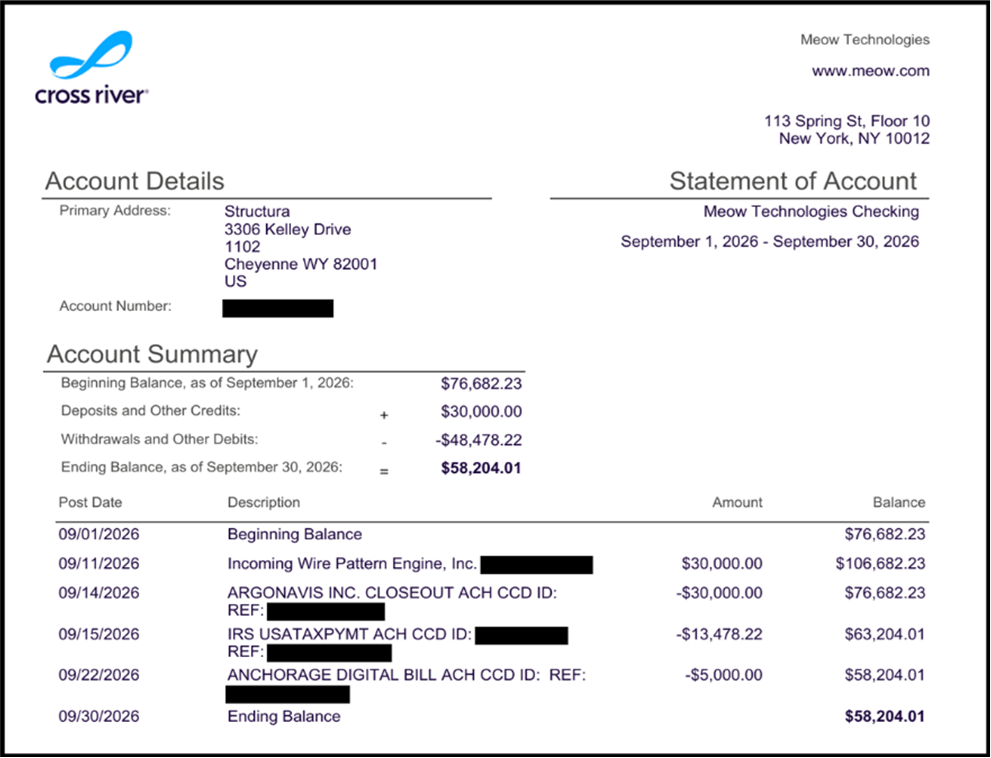
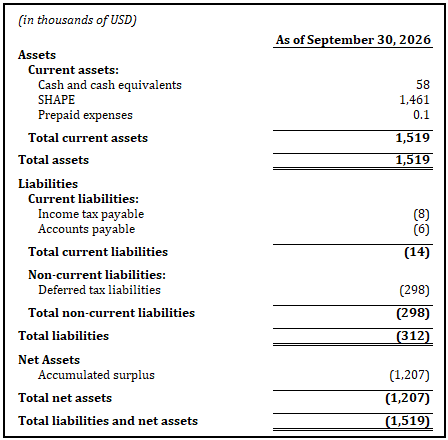
Cash and cash equivalents comprise cash held in Structura's business checking account. As of September 30, 2026, Structura held $58.2 thousand of cash in that account. Cash on hand is designated to fund Structura's operating and tax obligations.
The cash balance decreased from $86.7 thousand on June 30, 2026 to $58.2 thousand on September 30, 2026. During the quarter, Structura received a $30.0 thousand related-party cash contribution from Pattern Engine, Inc. in September 2026 (see ITEM 5. Statement of Income) and made the following payments: $30.0 thousand to ArgoNavis, Inc. (Agora) on September 14, 2026 under the closeout agreement; $15.0 thousand of Anchorage custody fees for the June through August 2026 service periods; and $13.5 thousand for the third-quarter federal estimated income tax payment on September 15, 2026.
Digital Assets
As of September 30, 2026, Structura's treasury held 5,035.9 million SHAPE tokens valued at $1.5 million, together with a nominal balance of ETH. Of the SHAPE tokens held, approximately 1,930 million tokens ($0.6 million) are held across the operating treasury wallets and approximately 3,105.9 million tokens ($0.9 million) are held in the UNA Safe multi-signature wallet reserved for future staking-reward allocation. The SHAPE treasury position of $1.5 million remains Structura's principal asset and is subject to market fluctuation; carrying value reflects the spot price of approximately $0.00029012 per SHAPE at 11:59:59 PM Mountain Time on September 30, 2026.
Structura's digital asset holdings of $1.5 million on September 30, 2026 represent a decrease of $1.6 million compared to $3.1 million on June 30, 2026. The decrease is attributable entirely to the decline in the SHAPE token market price during the quarter, from approximately $0.00060875 to $0.00029012 per token (approximately 52%); no designated tokens were acquired or disposed of during the quarter.
Prepaid Expenses
Prepaid expenses relate to the upfront token payment to Administrator Services for DUNA administration services under a two-year contract term, recognized ratably over the contract period.
The balance decreased from $126 on June 30, 2026 to $105 on September 30, 2026 as the expense was recognized over the quarter.
Liabilities:
As of September 30, 2026, total current liabilities (due within one year) were $14.0 thousand and non-current liabilities were $297.9 thousand. The non-current balance consists entirely of the deferred tax liability described below.
Income Tax Payable
As of September 30, 2026, income tax payable was $8.3 thousand. The balance reflects year-to-date federal income tax liability of $23.5 thousand, computed at the 21% federal rate on year-to-date taxable income of approximately $111.8 thousand, net of the $1.7 thousand second-quarter and $13.5 thousand third-quarter estimated tax payments made to the IRS, with the third-quarter payment made on September 15, 2026. The year-to-date liability already reflects the $3.2 thousand current income tax benefit arising from the quarter's taxable loss (see ITEM 5. Statement of Income).
Accounts Payable
As of September 30, 2026, accounts payable were $5.8 thousand, comprising the unpaid September 2026 custody fee invoice of $5.0 thousand and accrued 2026 tax return filing and review fees of $0.75 thousand.
Accounts payable were substantially unchanged from $5.5 thousand on June 30, 2026: the $30.0 thousand paid to ArgoNavis, Inc. ($25.0 thousand of governance management services fees for April 11 through September 9, 2026 and a $5.0 thousand early termination cost) and the June through August custody fees (including the June fee outstanding at June 30, 2026) were paid before quarter end, leaving only the September custody invoice and the accrued filing fees outstanding.
Deferred Tax Liabilities
Deferred tax assets and liabilities represent the estimated future income tax effects of temporary differences between the carrying amounts of assets and liabilities for financial reporting purposes and their respective tax bases. A deferred tax liability reflects income taxes expected to become payable in future periods as those differences reverse, and a deferred tax asset reflects income tax benefits expected to be realized in future periods.
As of September 30, 2026, Structura carried a net deferred tax liability of $297.9 thousand. The balance is attributable principally to the cumulative net unrealized gain on Structura's designated-token holdings, which are carried at fair value for financial reporting purposes while the related gains are not recognized for tax purposes until the tokens are disposed of; the 21% federal corporate income tax rate applied to this cumulative unrealized position of $1.4 million produces the deferred tax liability.
The net deferred tax liability decreased from $634.9 thousand on June 30, 2026 to $297.9 thousand on September 30, 2026, reflecting a net deferred income tax benefit of $337.0 thousand recognized during the quarter, driven by the decline in the SHAPE token price, which reduced the cumulative net unrealized gain.
Net Assets:
Accumulated Surplus
Accumulated Surplus represents the cumulative net profits of Structura. Each period, it rolls forward pursuant to the following formula: Beginning Accumulated Surplus + Net Income (or – Net Loss) = Ending Accumulated Surplus.
For the current period, Beginning Accumulated Surplus is $2.5 million. Net Loss for the quarter is $1.3 million per ITEM 5. Statement of Income, resulting in Ending Accumulated Surplus of $1.2 million.
Commitments:
Vendor Purchase Obligations
As of September 30, 2026, Structura had approximately $140 thousand in outstanding vendor purchase obligations, consisting of the remaining amounts due for custody management services under the three-year custody agreement. The $60 thousand governance management services obligation (one-year term starting in April 2026) was extinguished upon the early termination of the Agora agreement during the quarter (see ITEM 5. Statement of Income).
ITEM 5. Statement of Income (unaudited) – For Informational Purposes Only
Summary of Operating Activities:
Revenue
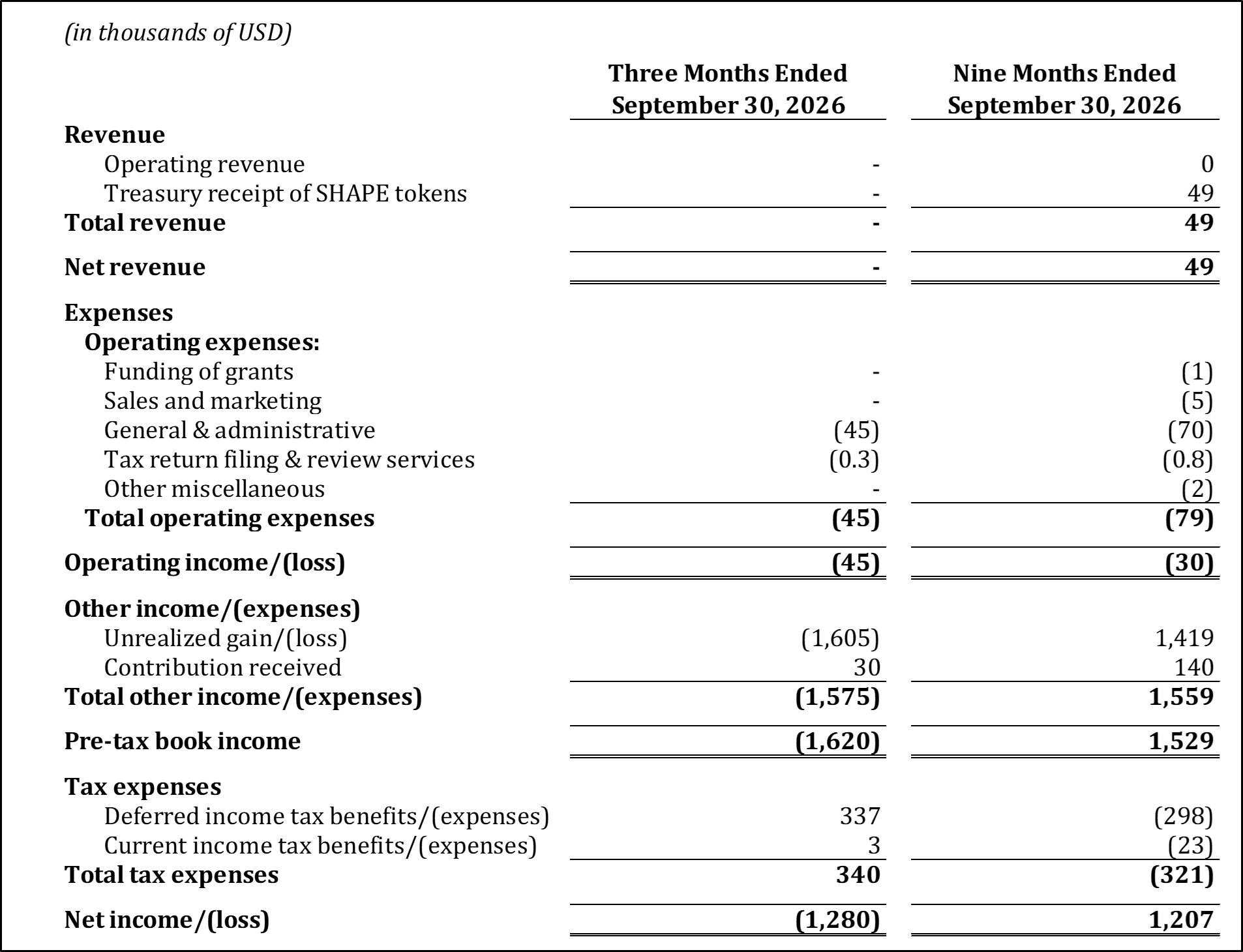
Structura recognized no operating revenue for the three months ended September 30, 2026. Year-to-date revenue of $48.7 thousand was recognized entirely in the first quarter and consisted substantially of SHAPE tokens received into the treasury following the token generation event. No designated tokens were received as recognized revenue or disposed of during the third quarter.
Operating Expenses
Operating expenses for the three months ended September 30, 2026 were $45.3 thousand, compared to $16.1 thousand for the three months ended June 30, 2026, and year-to-date operating expenses were $78.6 thousand. The notable third-quarter items were the following:
- General and administrative expense of $45.0 thousand, consisting of $25.0 thousand of governance management service fees incurred under the Agora agreement for April 11 through September 9, 2026, a $5.0 thousand early termination cost, $15.0 thousand of token custody management fees incurred (three months at the $5.0 thousand monthly fee), and $21 of ratably recognized Administrator Services administration fees.
During the quarter, the hosting of the Structura governance page was moved off Agora's platform and is now serviced by Administrator Services. The service period under the Agora agreement began on April 11, 2026 and ended on September 9, 2026. The $30.0 thousand closeout payment agreed with Agora settled all amounts under the agreement; the $5.0 thousand in excess of the fees for services rendered through September 9, 2026 is presented as an early termination cost, and no further amounts are due to Agora.
- Tax return filing and review services of $0.25 thousand, representing accrued 2026 federal tax return filing and review service fees.
Other Income (Expenses)
Structura recognized $1.6 million of other expenses for the three months ended September 30, 2026, comprising a $1.6 million unrealized loss on the SHAPE treasury position, partially offset by a $30.0 thousand cash contribution received from Pattern Engine, Inc., a related party of the Association, to support the settlement of final vendor obligations. The unrealized loss equals the period fair-value change in the value of the treasury and is excluded from current taxable income because the tokens have not been disposed of.
Income Taxes
Income taxes comprise current and deferred amounts.
Current income tax applies the 21% federal rate to current taxable income (realized income less tax-deductible expenses, excluding unrealized gains and losses). The taxable loss for the three months ended September 30, 2026 was approximately $15.3 thousand, producing a current income tax benefit of $3.2 thousand for the quarter; year-to-date taxable income was approximately $111.8 thousand, resulting in year-to-date current income tax expense of $23.5 thousand. The quarter's taxable loss primarily reflects the deductible Agora governance management services fees and early termination cost, as well as custody fees, partially offset by the $30.0 thousand contribution received from Pattern Engine, Inc., which is treated as taxable income at the time of receipt.
Deferred income tax reflects the expected tax effect of current-period unrealized gains or losses, which are excluded from current taxable income. Structura's $1.6 million unrealized loss for the quarter results in a deferred income tax benefit of $337.0 thousand at the 21% rate, and the $1.4 million year-to-date cumulative unrealized gain results in a year-to-date deferred income tax expense of $297.9 thousand. Structura recognized a net loss of $1.3 million for the three months ended September 30, 2026, compared to net income of $0.5 million for the three months ended June 30, 2026, and year-to-date net income of $1.2 million.
ITEM 6. Statement of Digital Assets (unaudited) – For Informational Purposes Only
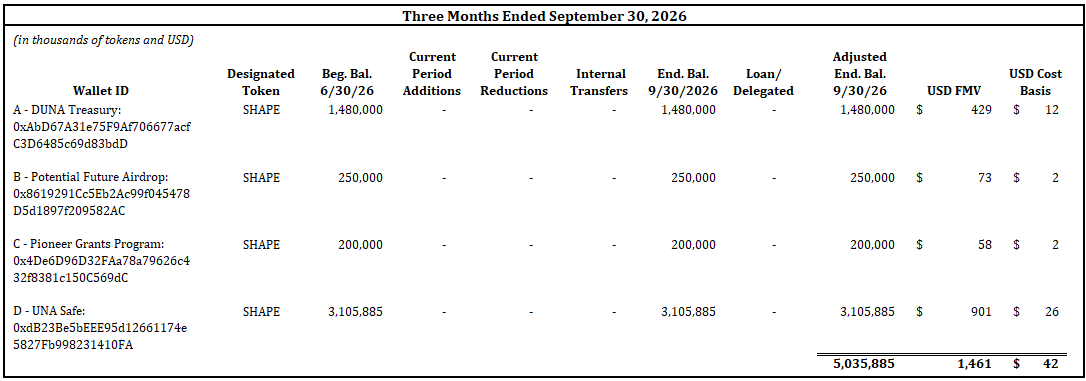
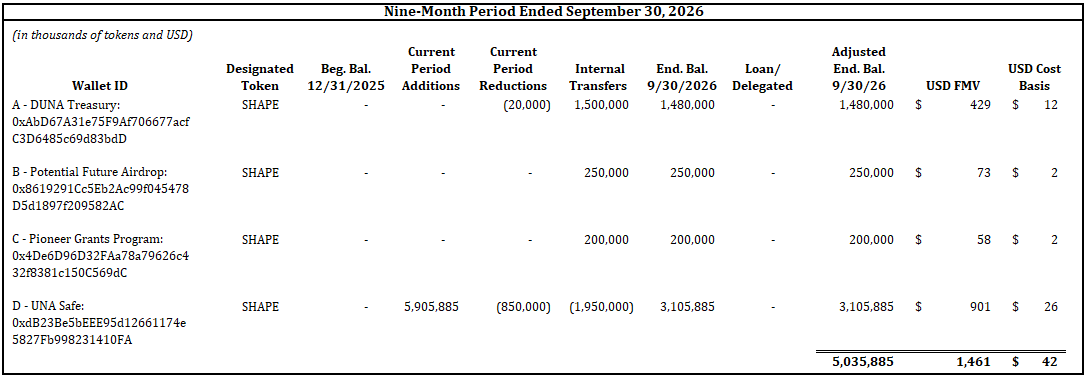
There were no digital asset movements during the three months ended September 30, 2026; wallet token balances were unchanged during the quarter. The UNA Safe multi-signature wallet balance of 3,105.9 million SHAPE tokens remains reserved for future staking-reward allocation.
Note:
The Statement of Digital Assets is a standardized, supplemental report that summarizes Structura’s digital asset positions and activity. It rolls forward wallet token balances from the beginning of the period to the end of the period, and it also provides fair market value and cost basis figures by wallet. This information allows the reader to understand the potential tax consequences of future dispositions from the DUNA Treasury.
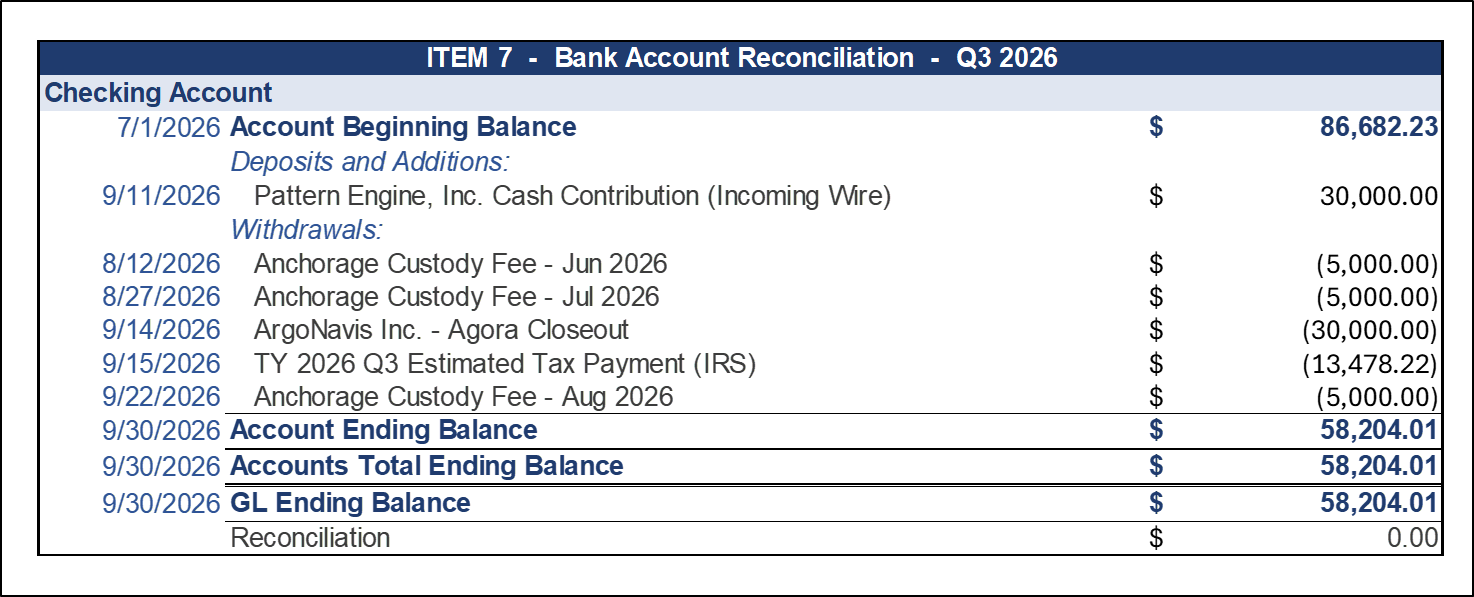
ITEM 7. Bank Account Reconciliation (unaudited) – For Informational Purposes Only